Showing posts with label history. Show all posts

Wednesday, August 12, 2015

Make Mine Maritime, Museum That Is

Maritime Museum of the Atlantic.
While at the waterfront, I took a quick but fascinating swing through the Maritime Museum of the Atlantic.


It is a kid pleaser from the moment you walk in, thanks to a grisly recreation of a dead pirate hanging in a gibbet and to the Kraken that looms in a corner upstairs.


An adult pleaser, too. What's your craft? Small boats, large boats/ships, working boats/ships, pleasure boats/ships, oars, steam or sail? All are here, life-sized or models.


 Particularly interesting and poignant, especially to the non-nautically inclined, are re-creations and artifacts from the doomed HMS Titanic and its passengers. A wooden deck chair from the elegant liner, pieces of carved wood decorative elements, a mortuary bag. So sound a sleeper was Halifax millionaire George Wright that he slept through the alarms and was lost at sea.
Of course there is an exhibit on Samuel Cunard, the native son who became a shipping magnate and whose name still graces the world's only regularly scheduled ocean liner service between Great Britain and the United States.

Another fascinating section is dedicated to the Great Halifax Explosion, a temporary exhibit so popular with Haligonians that it is now a permanent fixture.

Canadian Museum of Immigration at Pier 21.
The next day, the Good Girls returned to the waterfront. We had a grand time learning about the 1.5 million immigrants who came to Canada through Pier 21, the Canadian Ellis Island,  between the 1920s and 1970s. Our visit to the Canadian Museum of Immigration at Pier 21 was, for non-Canadians, surprisingly interesting.


Etiquette Lesson
Would you have arrived as a first, second or third class passenger? See if you can pick out and properly set your china and glassware.

First class setting.

Which fork?


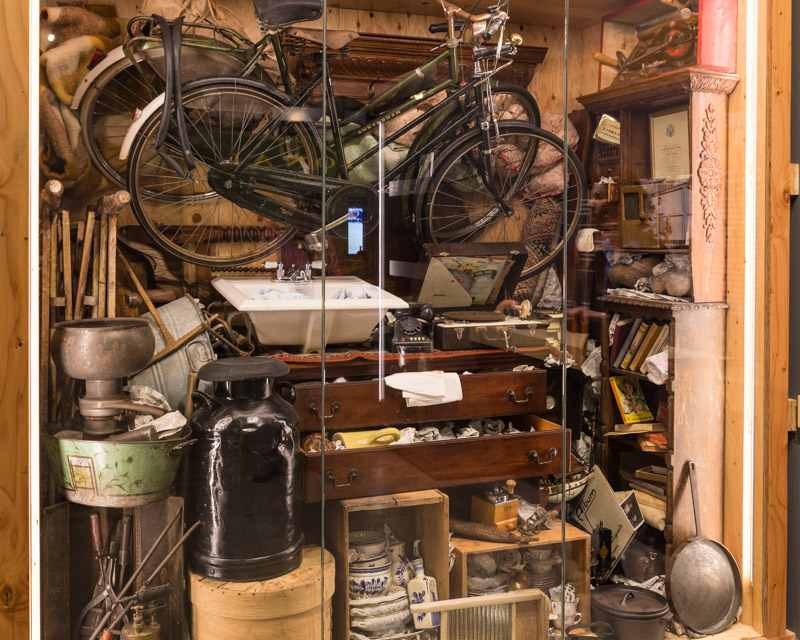
After World War II, one of the biggest waves of immigration occurred. Canada needed farmers, the Netherlands had farmers and many came with $100 per family and a kist, a box of everything they expected to need for their new life on a Canadian farm. The contents of these, some as large as a two-car garage, are fascinating.
Sample kist.
Kist Up Close

On the train car west.
Daunting is the word for the train trip that took them from Halifax to Vancouver. We sat in the model train car and tried to imagine what life in those packed cars must have been like.

Debi and Judy.
We didn't have to imagine the nurses who examined immigrants because in typical Good Girls style, we tried on their uniforms.

Don't miss the very good museum store on the first floor.

Monday, November 3, 2014

Historic Brattonsville: From the American Revolution to Antebellum South


Historic Brattonsville is a 775-acre, internationally known historical site and living history museum in South Carolina. (Just the kind of place I love.) The number of visitors increased exponentially when the location was chosen for filming The Patriot, starring Mel Gibson. At Brattonsville, you not only step back in time, you leap into the emotional conflicts of war and slavery. Our interpreter, Dontavius Williams, was extraordinary. He guided us through many buildings on the site tracing the history of the Bratton family and the farm workers from the 1760's to the late 19th century. His tales are spell binding.  
Dontavius Williams welcomes visitors to Brattonsville.

First we stopped by the Visitor's Center and saw a movie about Huck's Defeat, a complex series of skirmishes that happened in this area during the Revolutionary War. The British militia had entered South Carolina's backwoods and local tradition states that Martha Bratton sent a trusted African-American slave named Watt to find her husband and warn him of the British. Captain Huck, a loyalist,  interrogated Martha, but she refused to give him any information. Watt's delivery of the message lead to the destruction of Huck’s Loyalist force. The victory helped revive the morale of the people in South Carolina just when British victory seemed inevitable. It served as a rallying point and set into motion a series of significant events which eventually led to the even larger Patriot victories, and finally to the British surrender at Yorktown in October 1781.

Historic Brattonsville includes a working farm and heritage breed animals. We stopped by the milk barn, hog pen, tool shed, smoke house, corn crib and the backwoods cabin. These are the kind of buildings children really love. We entered the original Bratton House, a log house with one room downstairs and one upstairs. The family soon opened a tavern nearby and later added the schoolhouse wing. All of these buildings are now grouped close together for ease of viewing.


Tavern and Schoolhouse


The formal Dining Room
We crossed the street and stepped into the impressive Homestead which was built between 1823-26 The Brattons were a wealthy, influential family and their home reflects their high social standing. One of the rooms was used by Dr. John Bratton for his medical practice. He is noted for treating hundreds of people, both black and white. Three of his sons also pursued medical careers. The grand dining room was set for a banquet and we just had to have our pictures taken there, as this room was shown in the movie.


The main Homestead at Brattonsville

The highlight of our tour came when we visited the slave house. Dontavius disappeared into the dwelling and when he reappeared, he had a new persona; he was Adam, a slave who worked on the property.  Adam told us the impassioned story of his mother and the spirit doll. He presented each of us with a similar doll and I will always cherish mine. We left with a better understanding of the sacrifices made by both slaves and their descendants.   
Dontavius at Adam


We hope you will take the time to watch the YouTube version of Adam's speech. He is moving.


Monday, October 13, 2014

Tangible history fills South Carolina's Union County

Rose Hill Plantation

The people who tell you about the history of Union County in South Carolina are probably related to the people who made it.

Rose Hill dining room.
Take Rose Hill Plantation, a State Historic Site 8 miles from the county seat of Union, SC. Begun in 1811 by Francis Fincher Gist, whose family laid out the city of Baltimore, MD, it is best known as the home of his illegitimate son, William Henry Gist. William, a lawyer, state representative and governor, remodeled the house, adding front and back two-story porches and covering its bricks with white-painted stucco.

General and Governor William Gist
He was an outspoken advocate of slavery, having turned his 5,000 acres into a working plantation with a slave population that grew from 20 in 1818 to 178 in 1860. Secessionist William even fought a duel with his State's Rights nephew. When elected governor, William became known as the "secessionist governor" and from 1858 to 1860 the three-story home served as the Governor's Mansion. David, one of two sons to survive to old age, fathered 25 children; the last granddaughter died a matter of months ago. Need I say there are a lot of Union county residents, black and white, named Gist?
Graceful bannister at Rose Hill

Cross Keys House
 As we headed into Union, we passed the Cross Keys House, site of an old stagecoach stop and circa 1809 post office at the intersection of the Old Ninety-Six (Old Piedmont Stage) and the Old Buncombe (Charleston) Roads. Completed in 1814 by Barrum Bobo (southern for Beaubeau, his family were French Huguenots), a prosperous merchant, it is an excellent example of Georgian Colonial style.

Jefferson Davis stopped here April 30 for lunch during his flight from Richmond and every April some 1,400 re-enacters recreate the event and its times. Held in the Bobo family until 2006, it is now owned by the Union County Historical Society and is open for tours on Saturdays.

It wasn't Saturday so we paused instead of toured, but the house has survived four earthquakes so that, too, can wait for a later date.

Union's Main Street where you'll find its museum.
We did stop at the fascinating Union County Museum in Union, where historian Ola Jean Kelly, who had accompanied us on our morning tour, pointed out some of the highlights of the 5,000-square feet of collections:

This dress brought seven brides good luck.
• Display of wedding gowns from 1825, including one worn over the years by seven brides.

Revolutionary War SC battle flag
• Two of the three South Carolina flags remaining from the Revolutionary War.

Secession table
• The table of secession upon which Benjamin F. Arthur of Union County drafted the Ordinance of Secession in Charleston, Dec. 20, 1860.

We were tickled to find out where the expression, "We'll thrown you under the jail" may have originated. No prisoners ever escaped from Union County's jail because they were housed underneath it, literally. So were those in Chester County but that's a story for the next post.

We ended our brief visit to Union County with a truly memorable meal at Midway BBQ in nearby Bufffalo, SC. The venerable establishment is now run by Jay Allen and owned by his wife, Amy, whose father was founder Jack O'Dell.

Jay Allen keeps the hash pots simmering.
Both Southern Living and Garden and Gun have sung its praises and it doesn't take long to see why when you enter this combination butcher shop, restaurant and community gathering place.

Everything edible here is good.
It is justly famous for its Carolina hash, a state specialty. Not pretty to look at but delicious to taste is this melange of beef (occasionally up to 5 percent pork), onions and butter assembled and cooked over a 24-hour period. It is what many diners drive 100 or more miles to eat. Equally famous should be the chicken stew, a rich bisque that soothes the soul with heartiness but would be right at home in a bone china bowl at a gourmet gathering.

We tried to sample it all.
Good Girls never quit so soon, though, and we tasted our way through the excellent pork barbecue, the sublime squash casserole, tangy turnip greens and a sweet potato souffle more satisfying to the sweet tooth than most desserts.

The things we do for our followers, burp.


Monday, October 6, 2014

South Carolina, a Peach of a State

South Carolina-grown Big Reds.
The Good Girls couldn't leave the Old 69 District of South Carolina without a word about peaches.

From beginnings near the city of Xian, China, where peaches were cultivated at least 3,000 years ago, the luscious fruit was spread o Russia and Persia. Alexander the Great and his armies bartered for them and spread the peach to Greece and from there to Europe. The Spanish brought peaches to the New World and today they are grown in 64 countries. Especially the Old 69 District of South Carolina.

Discovered there in the late 1600s, peaches became a major crop in the 1900s. During the mid-May to Labor Day season, weather permitting, 200-plus million pounds are harvested, more than in any other state except California. Yes, even more than in the "peach state" of Georgia. On the 5,100 acres of Titan Farms, the area's largest grower, more than 56 varieties are grown.

Carolina peaches ready for market.
We could not have been more delighted when honorary Good Girl Vicki Loughner brought us each a basket of Big Reds, one of the 70 different varieties grown here.

Timing wasn't good for what is considered a very perishable fruit; we had two more nights in the area plus another three in the Olde English district and a day's drive home.

 We needn't have worried. Treated right, truly fresh peaches are pretty hardy. Upon checking out of the Greenwood Fairfield Inn & Suites, we carefully placed our baskets in the car's back seat and floorboard, covering them with a windshield sun deflector. After checking into the Rock Hill Marriott Courtyard, we transferred them to a spot closest to the air conditioner in our rooms, repeating the process when we checked out and headed for home.

It worked. All peaches arrived deliciously edible. I managed to make a cobbler, a pie, have peaches on cereal every morning and put up fthree pint bags of perfect peaches just before going out of town nine days later. Debi's experience was similar.

Peaches on the tree in South Carolina.
Our advice, buy peaches from 300 miles away instead of 2,000 (South Carolina peaches can be bought on line). Keep them cool then allow to return to room temperature the night before you plan to use them.

Enjoy.

The big peach we passed on the road.


Monday, September 29, 2014

Abbeville, History in every brick and board

Approaching Abbeville Square.
Drive up to Abbeville's square and you want to find a parking spot. Whether to sit on a bench in the shady park, to see what's showing at the Opera House or to explore what is inside the antebellum and early 1900s buildings, it calls to you.

Pull in and stay awhile.
There never seems to be enough time to do Abbeville justice which requires shifting your pace back 100 or so years.

Abbeville Opera House
Take the Opera House. Since 1908 Broadway's best have sung, danced and acted on its 7,500-square-foot stage. At the turn of that century, road shows traveled by train from New York to Richmond to Atlanta with an overnight stop in Abbeville. City fathers saw an opportunity and had the grand Opera House built. When movies began, it featured those, too, complete with orchestral accompaniment.

Imagine you imagine seeing plays from one of two stage-side boxes?
Today it has been restored to its 1908 glory with two additions, rocking chair seats and air conditioning. Stagehands still use the same rope-pulled rigging as in 1908. Named the official State Theater of South Carolina, Abbeville's Opera House is on the National Register of Historic Places, not to mention showcasing a year-round schedule of live productions.

I hope ghosts are still wandering around the Belmont Inn.
On one side stands the Courthouse and City Hall, across the street on the other side is the Belmont Inn, where those Scandals and Follies performers stayed, although they knew it as The Elysium. The venerable hostelry has been renovated by new owners since I spent a night there and I have to wonder if the ghosts stayed on.

The most notable was the chorus girl who wandered through the rooms looking for her favorite bracelet. She died never knowing it had been taken by another chorine. A colleague swore she had seen the apparition in her room during the night.

Burt-Stark Mansion
There isn't really anything left by the French Huguenots who founded Abbeville in 1764, but the town is rife with Civil War reminders.  It is, in fact, known as the cradle and the grave of the Confederacy. A tour of the Burt-Stark Mansion will explain.

On a hill now known as Secession Hill, the meeting that launched the state's secession from the Union was held on Nov. 22, 1860. According to our guide, the Articles of Secession were written at the Greek Revival mansion which had been built in the 1830s by David Lesley, a planter, lawyer and district judge.

Five years later, April 9, 1865, as the surrender of Richmond was expected any day, Varina Davis, wife of Confederacy President Jefferson Davis, and their children fled and took refuge in the house of their old friends, Armistead Burt, a former U. S. Representative, lawyer and Major in the Confederate Army, and his wife, Martha.

They left at month's end and around noon, May 2, Jefferson Davis arrived with his entourage. After eating, Davis, four of his cabinet members and five Brigade Commanders gathered in the gentleman's parlor for the last Council of War. Davis thought to gather the remains of the army and continue to Texas where they could raise more money and soldiers to fight on. His generals knew better and in the end, Davis was convinced that "All is indeed lost."

Did Judah P. Benjamin hide the Great Seal of the Confederacy here?
Also lost was the Confederacy's Great Seal. One theory has it being buried on the grounds around the mansion.

The Adam fan light of fleur de lis Burt had installed in the 1860s to honor his wife's Huguenot heritage; the red shows she was not of royal descent.
In all, Davis spent about 12 hours here, but they were decisive ones. Following the war, Burt, who had risked his life sheltering the Davises, was broke and in 1868, sold the house. In 1913 it was bought by cotton broker James and Ann Miller Stark. Their daughters were the last residents; in 1987, Mary Stark Davis willed the house to the Abbeville County Historic Preservation Committee.

We  ran out of time and couldn't see the Abbeville Historical Society's 1888 Queen Anne style McGowan-Barksdale House.

Anyone who claims there's nothing worth seeing in these smaller towns has never taken the time to visit one.