Showing posts with label GA. Show all posts

Tuesday, September 3, 2013

Blue Ridge - Rediscovering a mountain getaway

Old homestead on Aska Road along the Toccoa River. Photo © by Judy Wells.
I had been to Blue Ridge, population 1,209, many times, thanks to a cousin who lives there, and thought I knew the area with its peaceful views of mountains, rivers, streams and waterfalls.

Not quite. I knew the area and had seen its growth (double the number of vacation homes in 10 years), but hadn't explored downtown for many years.

West Main Street, Blue Ridge. Photo © by Debi Lander.
Won't make that mistake again because it's hopping. A world famous bamboo fly rod maker and school, a jewelry designer whose work is worn by Sports Illustrated swimsuit models, an olive oil and balsamic vinegar store, prize-winning cupcake bakers and innovative restauranteurs have joined the familiar line of art galleries and gift shops.
Vinegars at Blue Ridge Olive Oil Company. Photo © by Debi Lander.

After checking out Tank Town just down the road, we began our Blue Ridge visit at the Fannin County Chamber of Commerce and Visitors Center, meeting our hosts, Jan Hackett and Jode Hanson, and getting an overview of the town. Turned out to be a smart stop for any traveler with good free maps and a variety of self-guided driving, hiking and history tours.

Start with food

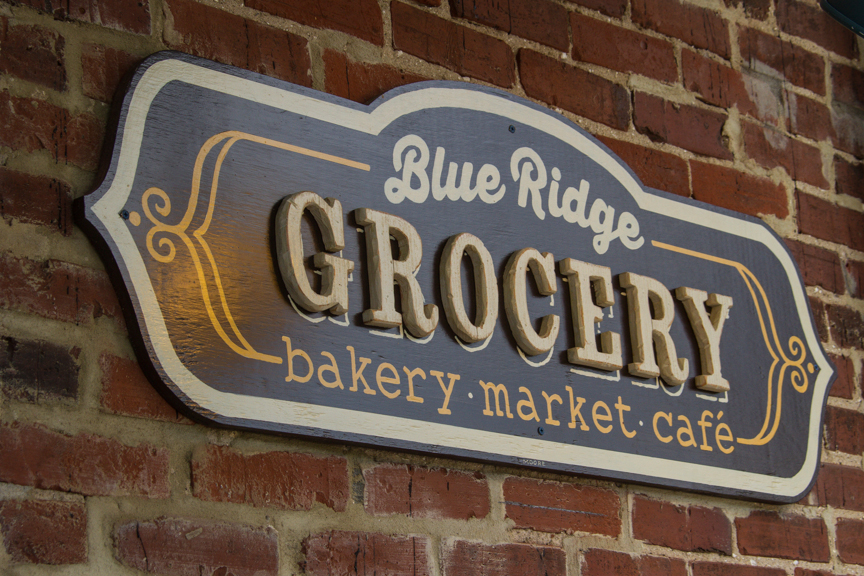
Driving tanks is hungry work so lunch was first on the agenda. Lucky us, it was at Blue Ridge Grocery, one of many projects of former editor and food writer Michelle Moran and her husband, Chef Danny Mellman.

Michelle Moran and Danny Mellman. Photo © by Judy Wells.
This creative couple have created two restaurants, a one-acre downtown farm where they created the Kids Farm to Table Camp and took an old downtown building and revamped the upstairs into urban cabin-style bedroom rentals.
Kale salad. Food photos © by Debi Lander.


Peaches-n-Cream pie.
Looking and sniffing around the aromatic Grocery with its made-in-house with local produce fare, we realized it was going to be tough to decide on just one thing. Lucky us again. Michelle had sampler plates brought out. Great kale salad, yummy sandwiches and, thanks to baker Heather MacLeod, a delicious peaches and cream pie.


Get the stories
Having sampled ourselves into satiety, we met with blonde and bubbly former Atlantan Lynn Kemp, who turned her jewelry making hobby into Gawdy Bobbles.
Bobbles. Photo © by Debi Lander.
Lynn Kemp. Photo © by Judy Wells.

What began with light-weight bangles in school colors has turned into an international business selling custom-crafted earrings, bracelets and necklaces for women - and men! - through boutiques, the internet and her small store in Blue Ridge.

Making Bobbles in Blue Ridge. Photo © by Debi Lander.
Sports Illustrated bathing suit models have worn her creations for the last two years and her jewelry has been singled out by CBS Atlanta and Parents Magazine.

It was singled out by us, too; we each left with a "starter set" of bangles.

Fashion tip for spring 2014 from Lynn: Look for natural and tribal tones.


 Just around the corner from Lynn's workshop is Oyster Fine Bamboo Fly Rods, otherwise known as nirvana for fly fishing devotees. Bill Oyster is renowned for his rods, each one made and engraved by his hand. Ninety rods a year is the output; most are custom made, but the few "standards" that slip out are quickly snatched up despite price tags that start at $2,390 and go up well into five figures (averages $4,000-$6,000 vs. $900 for best graphite rod).

Bill and his wife, Shannen, were out of town so we talked to Oyster's apprentice Riley Gudakunst. He told us the story of how Bill was a professional cyclist until  forced to retire following a bad crash. He liked to fly fish, but when wife Shannen found out how expensive bamboo fly rods were, she had a suggestion, "Learn how to make your own."
Riley, our Oyster guide. Photo © by Debi Lander.

He did and the rest is angling history, countless magazine stories and a devoted following that includes Pres. Jimmy Carter.

Oyster etching. Photo © by Debi Lander.
Bill is still the only professional rod-maker who does all of the hand engraving himself.

Evidently, that etched silver, gold or brass cap at the end is quite important to rod owners. One of Bill's makes the rod an heirloom piece.

Common area at Oyster Cast and Blast Inn. Photo © by Debi Lander.
Riley showed us through the workroom where the magic happens then told us about their school where anglers can make their own custom bamboo rod over a six day period; cost $1,570. After that it was up to the second floor to see The Oyster Cast and Blast Inn, four en suite bedrooms with common space that can be rented.

Like so many people you meet in Blue Ridge, the Oysters left the city for the quality of life and slower pace (and in their case, trout fishing) here, and started innovative businesses that are growing like kudzu.


Cupcake Wars winners. Photo © by Debi Lander.
We cruised some of the galleries and shops, including The Sweet Shoppe   where we picked up some of Nikki Gribble and Susan Catron's Cupcake Wars winning delights for snacks, then decided to catch a little natural beauty. There was just time before dinner at Chef Danny Melman's Harvest on Main to drive out and see Fall Branch Falls.
Fall Branch Falls. Photo © by Debi Lander.

It was a lovely interlude but our table awaited at the rustic lodge-like eatery with the fine cuisine.
Harvest on Main. Photo © by Judy Wells.

Considering how much we had left to see - not to mention eat - the Good Girls put Blue Ridge atop of their list for a return visit. Next time we rent a cabin, sit back and relax like everyone else who falls in love with this hideaway.
Fall Branch Falls. Photo © by Debi Lander.


Monday, August 26, 2013

Oak Hill, Martha Berry and her college


Martha Berry when presented at the Court of St. James. Photo © Debi Lander.
We were first attracted to Georgia's Rome because of its Southern version of Paul Revere (more about him later), but our attention was captured by Martha Berry, her home, museum and the schools she founded to educate the rural poor.

That her older sister became a globe-trotting, art-collecting Italian princess didn't hurt. You wouldn't expect less of the offspring of Thomas Berry who had been a lieutenant in the Mexican War, a Forty-niner in the California gold rush, married the daughter Alabama's richest man and was a captain in the Confederacy, after which he moved the family from Alabama to Rome to become a plantation owner and partner in a wholesale grocery and cotton brokerage.

Their home Oak Hill was filled with children, eight of their own plus the three orphaned by Mrs. Berry's younger sister's death.

Berry College and its wealthy supporters

Boys Industrial School
Martha adored her father and followed him on horseback as he rode his lands, checking on tenants and collecting rents. She saw first-hand the poverty of the area. What began as Sunday school stories told to area children in her log cabin playhouse turned into a school for boys and a separate one for girls, a two-year college and finally, in 1926, Berry College, a four-year institution where students worked for their tuition and graduated debt-free. In those days, only students from poor rural areas were admitted.

Berry College today. Photo © by Judy Wells.
She put them all on 83 acres across the road from Oak Hill, part of the inheritance from her father. Apparently as astute financially as he, she amassed more acreage as an investment for the college which now has the largest campus in the world, more than 27,000 acres where the deer outnumber the 2,000 or so students.

The Berry children had been reared as American aristocrats; their parents' wealthy northern friends would make annual visits to Rome and Oak Hill so they grew up with the country's elite.

Contacts Martha made good use of with a college to support. Henry Ford donated several buildings and President Theodore Roosevelt put the school on the national educational map when he visited in 1910. Presidents Harding and F.D. Roosevelt were also "collected" by Martha whose good friend Emily Vanderbilt Hammond visited at least annually through 1963 when she was 92.

Martha's desk. Photo © by Judy Wells.
Ever the diplomat, Martha had two pictures for her desk. If expecting a potential Northern donor, Grant's portrait came out; if a Southerner, Lee's. 


Martha at her desk. Photo © Debi Lander.


Berry College. Photo © by Judy Wells.
The college's stone buildings are expansive and impressive and the campus "grounds" - if you can call 27,000 acres by so mundane a term - are spectacular and open to the public. In addition to the college there's a dairy farm, stable (riding can be scheduled), two disc golf courses, two foster homes, elementary through middle schools, a couples' retreat center and camp for kids. 

It's well worth the drive through to catch glimpses of the 20 miles of walking trails and the vistas across the Appalachian foot hills between hardwoods and the long leaf pines Martha was instrumental in reintroducing. Wild turkeys are about as flighty as backyard chickens and the deer all but ask for treats. A fairly recent tornado took out 5,000 trees but you'd never know it.

The Old Mill. Photo © Debi Lander.
Do take the road to see the Old Mill, one of Rome's top attractions.  At 42 feet it's the world's second largest and tallest overshot wooden water mill if that means anything to you. Enjoy it for its idyllic setting and quaintness, but you'd do well to avoid the first Monday in October. That's the only day in the year when the mill actually works and it's also Mountain Day when Berry alums and supporters gather. Expect a traffic jam.

Oak Hill. Photo by Judy Wells.

Oak Hill

A winding road flanked by mature oak trees makes the arrival at Oak Hill a dramatic one. The striking white Greek revival mansion looms large but welcoming atop - what else? - a hill. Built in 1884 to replace the Victorian home that had burned, the interior of Oak Hill was totally remodeled in 1927, adding bathrooms, central heating, rearranging rooms and updating the kitchen.

The elevator. Photo © by Judy Wells.
Martha had developed a heart problem and an elevator was installed, a gift from from Berry alumna. It would get stuck so Martha asked for a chair, a light and a book to be added.


Dining room. Photo © by Judy Wells.
The house was truly a home and shows personal touches. Berry students, for example, made the dining room furniture; the coverlet on Martha's bed was made by her mother.
Martha's favorite room; coverlet made by her mother. Photo © by Judy Wells.

There is a portrait of Martha's African-American servant, Aunt Martha Freeman, supposedly the only person who could tell Martha what to do.


Princess Eugenia. Photo © Debi Lander.
Many of the furnishings are particularly fine. Martha's older sister, a wealthy widow, became Princess Eugenia Ruspoli when she married Italian Prince Enrico Ruspoli (17 years her junior) in 1901. With her money they purchased Castle Nemi near Rome from the Orsini family. Eugenia became a collector of good European furniture and art. She continued living in the castle after Ruspoli's death in 1909, but was able to get herself, her adopted daughter and the best of her collections to the U.S. before World War II erupted. The collections went to Martha for safe keeping and are now, like Oak Hill, part of Berry College.

Federalist mirror. Photo © by Judy Wells.
Chippendale, Federalist, Italian, Colonial, Berry student work all fits together and it takes a sharp eye to distinguish the extraordinary.

Outside the Colonial revival garden beckons. Walks, sunken gardens and ponds tempt visitors to explore and linger.

Bridal Walk, where Martha invited just married Berry students to make a wish at the wishing well in the gazebo. Photos © Debi Lander.


Garden photos © by Debi Lander.
It's a recovery in progress, says Oak Hill Director Tim Brown who hopes one day to have the lower garden cleared and pristine again.

Martha liked spires. Photo © by Judy Wells.
When I asked about the little white building with the cupola on top, Brown told me it was just a storage shed.

"Martha liked spires," he explained.

Martha's cars. Photo © Debi Lander.
There's also a garage with Martha's carriages and cars.


 Martha Berry Museum

Photo © Debi Lander.


Frieseke portrait. Photo © Debi Lander.
More of Princess Eugenia's art collection is on display at the Martha Berry Museum as are more of Martha's personal mementos and memorabilia as well as historical documents and accoutrements from the college.

Don't miss the art. There are some excellent Italian pieces and American portraits, plus Impressionist Frederick Carl Frieseke's painting of his daughter.
Some of Princess Eugenia's furniture. Photo by Judy Wells.

Deja vu

Oak Hill from the back. Photo © Debi Lander.
If, while you are wandering around the campus and Oak Hill, parts of it seem somehow familiar, it might be because scenes from the films Remember the Titans and Sweet Home Alabama were filmed here.


Monday, July 29, 2013

The Thrills and Spills of White Water Rafting in Columbus, GA

Rapids the morning of... Photo © by Judy Wells.

Twelve years ago the Chattahoochee River and the city of Columbus were in need of urban renewal.  But, the private and public sectors worked together to change the tide - literally.  Today, the city boasts the longest urban white water course in the world.

Do we really want to do this? Photo © by Judy Wells
 The Good Girls investigated some of the 15-mile Columbus RiverWalk in the morning- a place where folks stroll, exercise, bike, and fish.  When we got down to the area with rock studded “big water” I nearly changed my mind.  Recent rains have swollen the river and the water truly rushes along. This gnarly section of class 4 rapids (would have been class 5 if the course hadn't been groomed to prevent rafts getting hung up in rocks) looked more powerful than I could handle. Certainly Judy would need to back out as her recent recovery from a broken foot might be in jeopardy.

Debi and Ruth geared to go. Photo © by Judy Wells.
However, when 1:30 came and it was time to don a life jacket and helmet, I wasn’t about to let this opportunity slip by.  Ruth from Laurie Rowe Communications would join me instead of Judy. Casey, our raft guide from White Water ExpressOutfitters, was confident and couldn’t wait to give us an exciting adventure. 
Debi and Ruth learning how to go safely. Photo © by Judy Wells.

After a general group briefing, we hopped into the van along with our oars and were driven to the loading zone. No sooner did we enter the Chattahoochee River (I love saying that name) than we encountered our first series of rapids.  “Dig,” hollered Casey and the four rafters on board attempted to stroke together. 

The splash and spray of the river felt exhilarating as the sun was out and temperatures were running in the low nineties. Woo-hoo; bring it on. That was fun!

We lazed through the next section, the river doing the work of pushing the raft forward.  We enjoyed views of Blue Heron around the Habitat Pool, a man-made zone created by the river project engineers.  Shoal Bass, which spawn in rough water, have returned now that the river churns with rushing tides. In all, two dams were removed from the river along with any sharp rock formations.

Hitting high water. Photo © by Judy Wells.
Casey mentally prepared us for the challenging lower course and let those of us on the raft decide how we wanted to approach.  No wimpy rafters here, we choose the hot and spicy route. 

In high water, Photo © by Judy Wells.
Oh my gosh, we had a wild ride as our raft bounced along, waves crashing in and over the sides. I screamed- but with delight not fright. I momentarily thought we would flip, as the raft seemed to fold up in the middle.  Ruth fell forward while I slipped backward.  But, with Casey at the bat, no one fell out and we soon recovered control of the course.  Casey called for a high five of our oars and we were all elated. 

We were offered the option of running the course again, from a slightly shorter launching location. We all choose to return, so once again our raft bounced by the old brick denim mills at river’s edge and the newer convention center and historic downtown Columbus. How very cool to have what I think of as a rural adventure in the center of town.  No need to drive hours to a park and camp out in order to get to a white water course.  In Columbus, the adventure waits just outside your hotel or restaurant door. 

- Post by Debi Lander.